Understand
7 min
Is AI Making Us Lazy?
If we could summary this article, I would call it: "The Dichotomy of AI: Productivity Booster or Intellectual Laziness Catalyst"

This graph shows how long it took some of the most popular platforms to reach 100 million users.
Launched in November 2022, ChatGPT sprinted ahead, achieving this milestone fifteen times faster than Instagram. It was a seismic shift—the rise of generative AI for the masses.
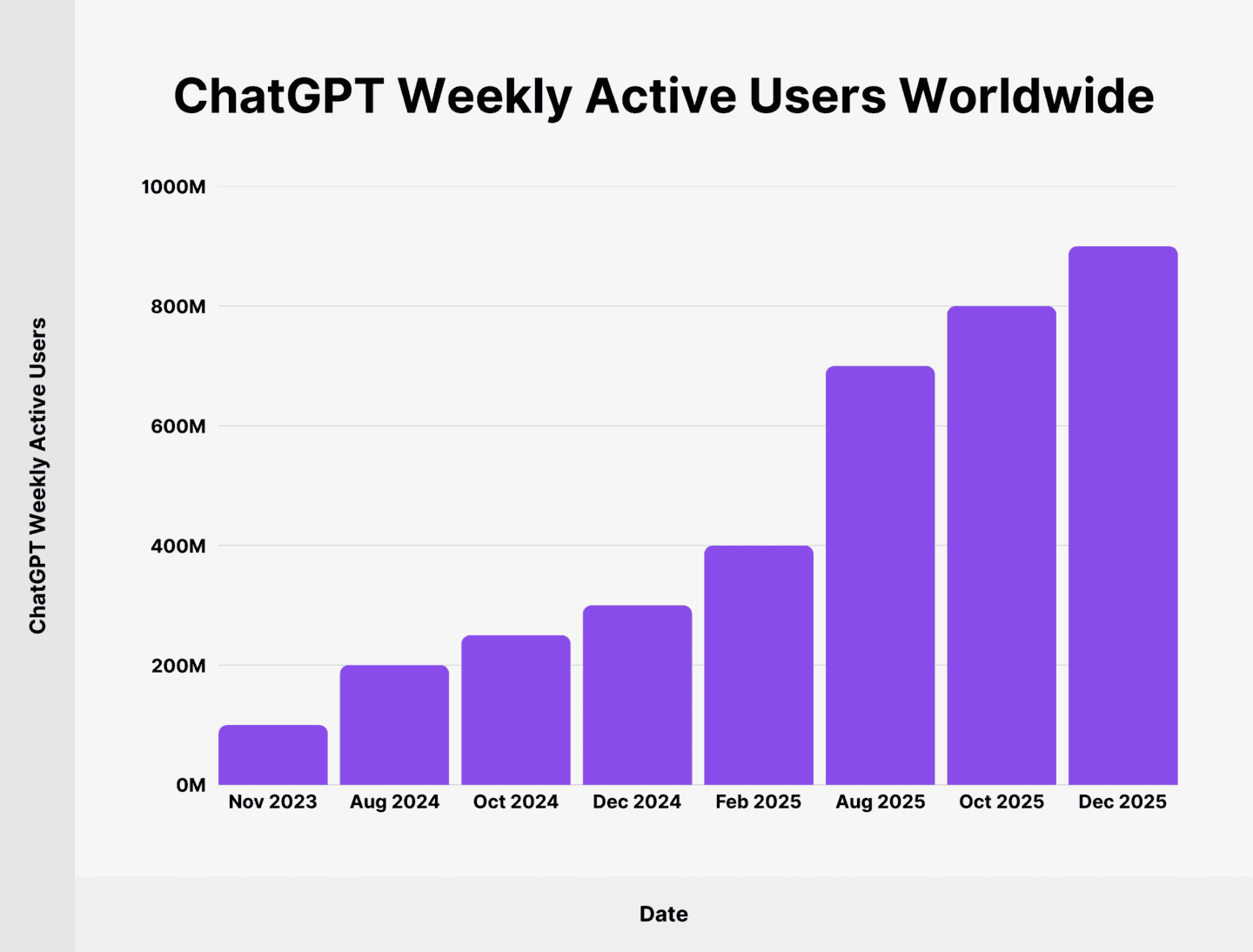
By December 2025, ChatGPT (Chat Generative Pre-trained Transformer) had around 900 million weekly active users. An astonishing adoption speed.
Many scientists see the current development of generative AI as an “Oppenheimer moment”—a time when a groundbreaking innovation with the power to reshape humanity is unleashed. Sam Altman, CEO of OpenAI (the company behind ChatGPT), might just be the Robert J. Oppenheimer of the 21st century. Interestingly, they share the same birthday—a fun fact for the superstitious.
Both share a belief in the unstoppable force of technological progress while harboring fears about their inventions’ potential to harm humanity.

My take on generative AI? Cautious fascination. As with many new technologies, it arrived without a user manual.
Yet, it’s destined to play an ever-growing role in our lives. Probabilities that OpenAI will die? Almost none. The key, then, is learning to coexist with AI—to harness its value without losing ourselves in the process.
A Compelling Promise
In France, ChatGPT is becoming increasingly integrated into daily life. As of November 2023: 65% of people under 35 and 67% of executives have used it.
Among users:
Unsurprisingly, these numbers keep climbing.
Easily automated tasks are gradually being delegated to AI. And that’s the allure: freeing ourselves from time-consuming, repetitive work so we can focus on high-value tasks. An opportunity to elevate human potential—work less but better, and faster.
With a co-pilot to help us soar even higher. Generative AI offers unprecedented convenience and efficiency for countless tasks. If Google amazed us by showing us where to find answers, ChatGPT takes it to the next level—it has answers (almost) ready for us.
Generative AI can serve as an assistant that empowers us: a potential catalyst for learning, curiosity, and exploration. But only if we use it wisely, keeping its role strictly supportive.
And that’s easier said than done.
Tech Dependency: A Race Toward Intellectual Laziness?
In Le Bug Humain, Sébastien Bohler describes the quest for minimal effort as one of humanity’s primary motivations: achieving the best results with the least investment.
It’s a natural inclination, rooted in our evolutionary need to conserve energy for survival in hostile environments. This predisposition to seek ease finds a perfect ally in generative AI—a tool that minimizes intellectual effort.
The risk? That AI could deepen our tech dependency while fostering intellectual laziness.

Using AI to solve problems for us is tempting, but it bypasses the brain’s learning process.
In 1975, psychologists Fergus Craik and Endel Tulving conducted a study called Depth of Processing, which revealed a fundamental principle: the more we engage with information, the better we understand and retain it.
Mastery is tied to the effort spent creating, analyzing, or evaluating something. And here’s the rub: the ease of unlimited access to information encourages superficial learning habits.
We take shortcuts. But for the brain to stay healthy, it needs to be exercised.
Here's a good comparison with football: It’s like winning matches because the opposing team forfeits. You get the points, but you don’t train or improve your skills. ⚽️
The more we rely on ChatGPT for quick answers, the less motivated we are to think critically or deeply. What starts as a tool for specific tasks can subtly feed our natural tendency to avoid effort.
Imagine these plausible scenarios:
“Can you suggest a gift idea for my girlfriend’s 30th birthday?”
“Can you write this Christmas card for my parents?”
“Can you dictate a message for my friend who’s going through a tough time?”

© From the movie "Her"
We lose some of the magic, don’t we? There’s value in the process, in the effort. Gratification, friction, and reflection are essential for intellectual growth.
The overpowering Ppotential of AI to exacerbate today’s tech dependency is real. Like any technology, AI can be a wonderful servant but a terrible master. The co-pilot must not take the wheel.

Human Cognition Will Become Increasingly Valuable
In this new paradigm, it quickly becomes clear that the most valuable skills will be those that are difficult to automate. These will be the deeply human abilities, such as:
Creativity
The capacity to generate innovative ideas
Curiosity
Emotional intelligence
Critical thinking
These “soft skills” (at least for now) remain beyond the full reach of AI.

To develop them, we require deep engagement with complex issues and rich interaction with the world around us. In short, exercising our brains. This is the opposite of the intellectual laziness that excessive reliance on technology can foster.
The biggest paradox: The very human skills most crucial to thriving in the AI era are also the ones most threatened by technological dependence.Ironically, in trying to boost our productivity with AI, we risk weakening the unique competencies that make us innovative and valuable.
Cal Newport emphasized this in Deep Work (2019):
“Those who specialize in tasks requiring complex thought, creativity, and a unique vision will hold a competitive advantage.”
The goal is to cultivate individuality—developing the ability to merge concepts and ideas in a way that reflects personal style, lived experiences, and expertise.
This requires attention, focus, and effort to build irreplaceable intellectual depth. Generative AI, while capable of producing impressive content, is rooted in statistical models and pre-existing knowledge. It often lacks the spark of spontaneity and creative intuition that define human ingenuity.
Our edge lies in our ability to step back, critique, and refine AI outputs. Protecting and nurturing these skills will be essential for the future.
Striking the Right Balance
The way we use generative AI will determine whether it enhances or diminishes our intellect. My view is that we should avoid both technophobia and tech dependency. We shouldn’t outright reject ChatGPT, but we also shouldn’t hand it the keys to our mental house.
By resisting the constant allure of convenience, we can leverage AI to boost efficiency while preserving and strengthening our most vital skills.
Take GPS as an example. In the past, we had to memorize routes, read road signs, and navigate unexpected detours. Now, GPS simplifies this process immensely.

© Photography by Kajetan Sumila
But many have seen their sense of direction deteriorate because they rely exclusively on Google Maps—even for short walks. We stop thinking about the route; we just follow instructions. This is the crucial distinction between assistance and dependence.
And the same applies to AI. Technological assistance is a boon, but technological dependence is a risk.
How to Find The Right Balance?
The idea isn’t to completely abandon generative AI and run away from it. Instead, it’s about using it while ensuring you always remain in control. To achieve this, we have two key pieces of advice to offer.
#1 - Take the Time to Think Independently
It’s essential to keep thinking for yourself. First, to avoid falling into laziness, and second, to keep your mind sharp and maintain critical thinking.
AI doesn’t always get it right—far from it. It can make mistakes, provide poor recommendations, just like humans. That’s why it’s important not to depend entirely on these tools but to question and critically evaluate the answers they provide.
This requires two key practices:
Engage in creative activities: Reading, writing, and continually developing new skills. The brain never stops learning, even after we leave school—it keeps growing!
Diversify your information and learning sources: Don’t rely solely on ChatGPT for your knowledge. New studies, articles, and recent information are published every day, and AI tools aren’t always up to date. That’s why it’s crucial to base your knowledge on multiple mediums and vary your sources!
#2 - Set Boundaries
Like any other app or tool you use, it’s crucial to approach it consciously and intentionally. Don’t let these tools become automatic habits!
To avoid this, we recommend setting usage limits for these tools. Once your “budget” is used up, it’ll be up to you to think critically. This will help you determine whether a particular activity is a necessity or simply laziness.
You can use the Jomo app, available for free on iPhone, iPad, and Mac. With Jomo, you can set two types of usage limits:
Number of openings (e.g., after 8 openings, the app is blocked)
Time limits (e.g., after 40 minutes, the app is blocked)
Opening Limits
What’s interesting about this method is realizing how often we use these tools for tasks we could easily handle ourselves. Human laziness often leads us to make poor choices!
By setting a maximum usage budget, you’ll need to ask yourself before opening the app: Do I really need this? Is this request worth using one of my precious openings?

Time Limits
We often lose track of how much time we spend using these tools. Generative AI can sometimes be tricky to handle, depending on the request. In the end, we may spend more time using the tool than if we’d simply done the task ourselves.
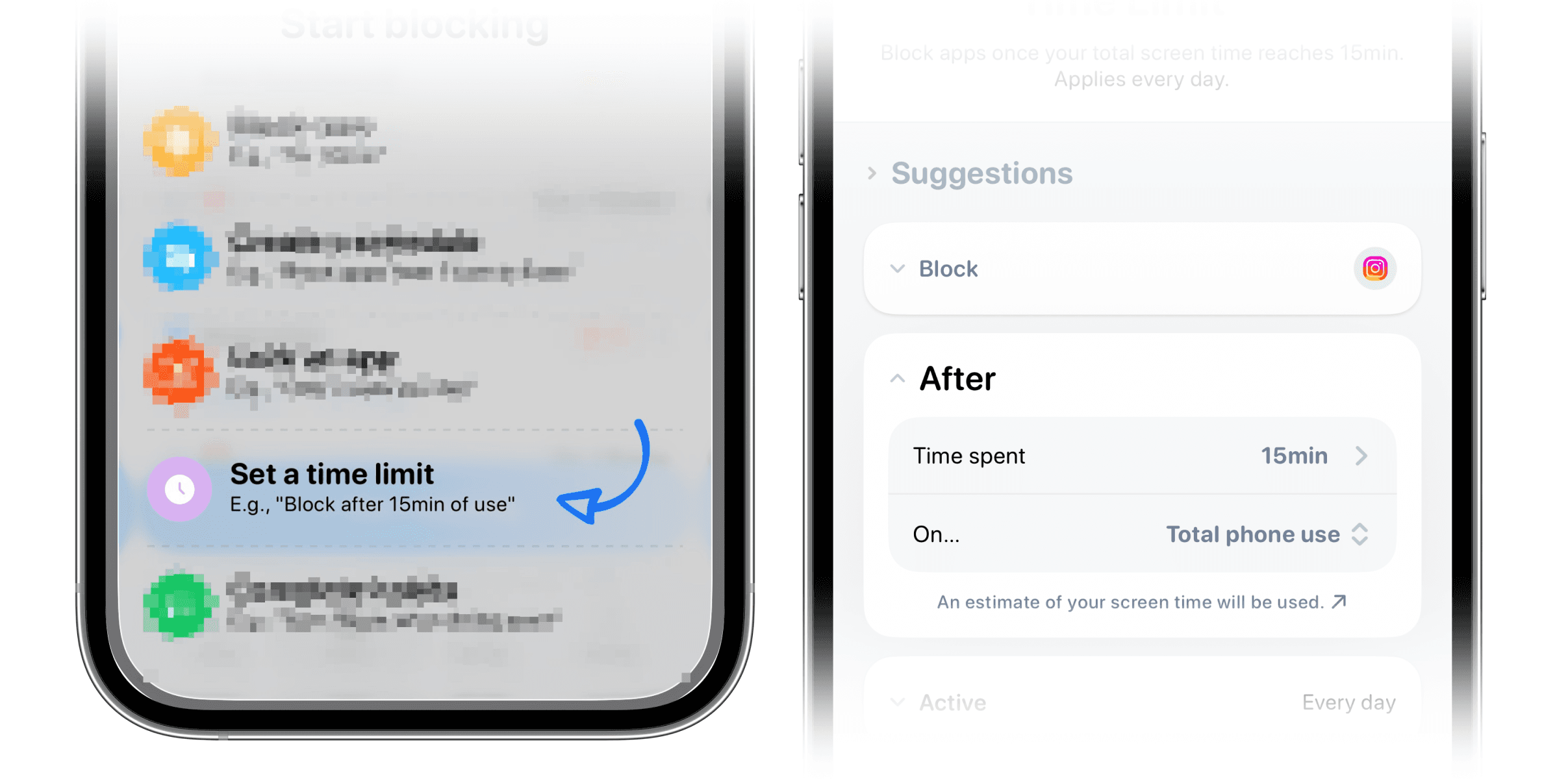
The idea here is to think: If I’m spending more than 30 minutes on these tools, it’s taking longer than the task itself would have taken. I’d be better off doing it myself!
That's it. In short, create a harmonious agreement with technology: let it be an extension of our humanity, rather than a substitution.